
Silver IRA Companies Compared 2026: Side-by-Side on 5 Operators
Companies featured here may provide compensation for click throughs. This is how I maintain free research for consumers. My full disclosure of who I invested with is on this page for transparency.
 By Tim Schmidt Sr.
Gold and Silver IRA Investor.
The short version: Augusta Precious Metals leads this side-by-side on the strength of an education-first desk and transparent pricing, with the tradeoff of the highest entry point in the group. We put five traditional silver IRA operators against the same five axes so you can read them on the terms that actually move a silver decision, not on ad spend.
Disclosure: This article may contain affiliate links. If you open an account through our links, we may earn a commission at no additional cost to you. Our editorial opinions are our own. Best Silver IRA Companies is not a registered investment advisor.
Disclaimer: This content is informational and does not constitute financial, tax, or legal advice. Consult a licensed professional before acting on any comparison below.
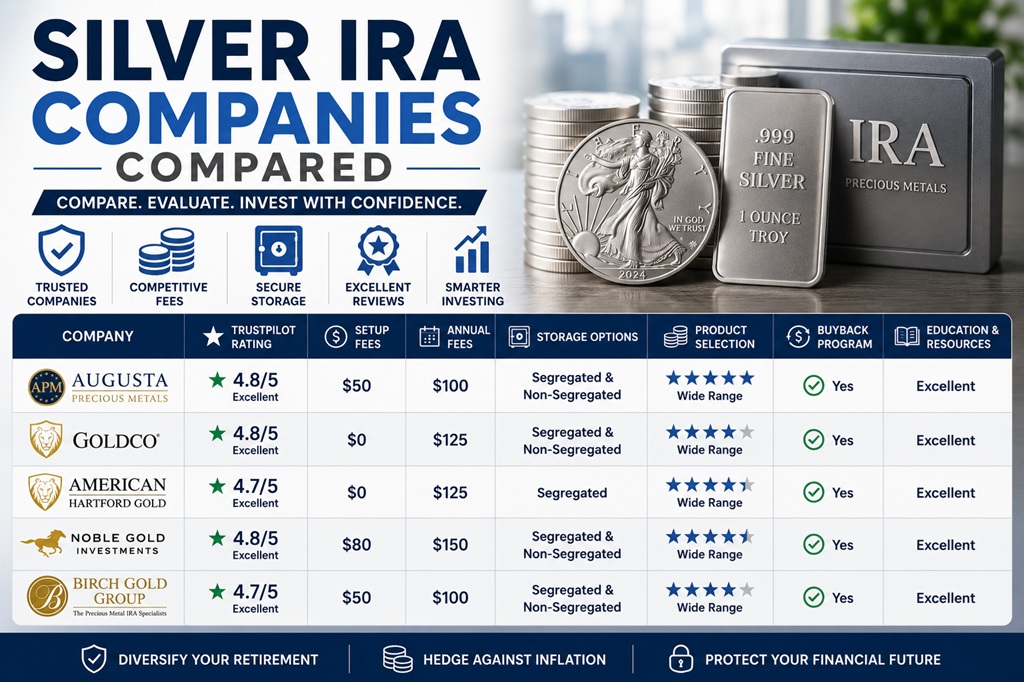
How We Compare Silver IRA Companies
Every honest silver IRA comparison collapses into five axes once you strip the marketing gloss. We score each operator on the range of eligible silver it will actually put in the account, the entry minimum stated in plain terms, how the metal is stored, how you sell it back, and whether the sales desk is built around education or a close. The five are listed below.
- Eligible silver range (how much of the catalog clears the fineness test the law sets)
- Account minimum (described in plain terms, low to high, not as a quoted figure that shifts)
- Storage model (segregated metal held apart, or commingled metal pooled in a shared allocation)
- Buyback and liquidity (whether a written sell-back procedure backs the exit)
- Service model (an education desk versus a commissioned push)
Two rules govern every verdict. Each entry leads with the computed result and then the record behind it, and no claim ships without a source you could pull yourself. Eligibility earns the first axis because it is fixed by statute. Under IRC Section 408(m)(3), an IRA may hold silver bullion only when it meets the minimum fineness a regulated futures contract requires, a 0.999 floor for silver, and only when that metal sits in the physical possession of an approved trustee rather than in your hands. Eligible bullion also has to come from a recognized mint or refiner, the kind whose bars clear the London Bullion Market Association good-delivery standard. A catalog that steers you toward semi-numismatic coins at rich premiums is optimizing for the desk, not for your account.
Why does storage sit so high on the list? Because the Internal Revenue Service requires the account to run through a qualified trustee, and the metal to rest in an approved depository under that trustee’s control, which is exactly where segregated and commingled models diverge. Segregated storage keeps your bars individually identifiable. Commingled storage pools them into a shared allocation you draw against. Neither is wrong, but the difference decides what you get back at distribution time, so we surface it for every operator rather than bury it. Our guide to which silver actually qualifies covers the fineness thresholds product by product, so we point you there instead of restating them.
One more mechanic shapes these rankings. Silver carries a wider dealer spread than gold, so the buyback axis matters more here than it would on a gold-only page, noted Sean Webster, the CPA who reviews every comparison on this site. A documented sell-back procedure is worth more than a warm assurance, because a thin market on the way out can quietly eat a share of the position.
The Five Silver IRA Companies at a Glance
The table below maps where each operator lands before the detailed verdicts, and it sits alongside our full silver IRA companies’ ranking for the head-to-head picture. Read it as a starting point, not the last word, because the axis that decides your choice depends on your balance and your appetite for hand-holding. Two operators carry the clearest written buyback language, one holds the highest minimum, and one keeps the widest depository network. Figures we could not confirm against a primary record are described in plain terms rather than presented as settled.
| Axis | Augusta | Goldco | Am. Hartford | Noble Gold | Birch Gold |
| Eligible silver | Bullion-focused | Bullion + coins | Bullion + coins | Bullion + coins | Bullion + coins |
| Account minimum | Highest here | Mid-tier | Low | Mid-tier | Low |
| Storage model | Commingled default | Both offered | Both offered | Segregated option | Widest network |
| Buyback | Assisted | Guaranteed price | Written commitment | Top-rated program | Specialist-assisted |
| Service model | Education-first | Rollover specialist | Low-entry buyback | Segregation focus | Education desk |
1. Augusta Precious Metals, the Education-First Benchmark
Verdict: strongest overall for a silver-first saver who can meet the entry point, earned on an education-first desk and pricing that third parties have singled out for transparency. Augusta Precious Metals runs a one-on-one web conference before you fund anything, and it pairs the account with Equity Trust as custodian, so the paperwork behind a silver purchase runs on established rails.
Its entry point is the steepest of the five, and that single fact is what puts Augusta beyond a saver who only wants a small silver sleeve. That high floor screens for size more than it shuts anyone out, since a flat annual cost thins out fast against a larger balance. On eligibility, the desk keeps the catalog focused on bullion that clears the 0.999 silver fineness floor rather than pushing collectible coins. Storage runs commingled by default through an approved depository, with the metal held under the custodian’s control. Money has named Augusta its Best for Educational Resources pick among gold and silver IRA companies, which is why we weight its service axis as the anchor of the score.
Where does Augusta lose a step for silver specifically? The buyback is an assisted process rather than a stated-price guarantee, so a saver who prizes a documented exit above all else may prefer an operator below.
Pros:
- Education-first desk removes the commissioned pressure regulators flag for older buyers
- Transparent, third-party-recognized pricing you can read before funding
- Bullion-focused catalog that respects the eligibility test
Cons:
- Highest minimum here prices out a small, deliberate silver position
- Commingled default storage rather than segregated as standard
Best for: A silver-first saver moving a substantial balance who wants the deepest guidance and the cleanest pricing.
See our current top-rated silver IRA pick
2. Goldco, the Buyback-Guarantee and Rollover Specialist
Verdict: strongest published buyback language, second overall. Goldco backs its silver with a buyback program it guarantees at the top of its own price range, and when the spread on the way out is as wide as silver’s, that written exit does most of the work of the account. Its core business is transferring a 401(k) or an existing IRA into a self-directed silver account, the exact move a large share of first-time silver buyers need to make.
The minimum sits in the middle of this group, accessible enough for a saver who does not want to overcommit to the metal on day one. On eligibility, Goldco offers both bullion and the eligible coin formats, all subject to the same 0.999 silver fineness test. Storage is available in both segregated and commingled forms through approved depositories, so a saver can pick the model that matches how they plan to draw the position down. The rollover machinery here is well practiced, which matters because a botched transfer is the most common way a first silver purchase goes sideways.
Does the highest-price guarantee bind in every market? Read the settlement terms, because a buyback is only as strong as its written window. For a saver whose first priority is a clear sell-back and a clean rollover, though, the liquidity signal here is the plainest in the group.
Pros:
- A top-of-range price guarantee gives the plainest read on liquidity in this field
- Deep rollover experience across workplace and IRA sources
- Choice of segregated or commingled storage
Cons:
- Stated minimum is higher than the lowest-entry operators below
- Free-metal promotions require reading the premium math before you accept them
Best for: A saver consolidating a 401(k) or IRA into silver who wants a documented, highest-price buyback.
3. American Hartford Gold, the Low-Entry Buyback Pick
Verdict: best written buyback at a low entry point, third overall, built on a published buyback commitment and one of the most accessible minimums among established dealers. American Hartford Gold posts a buyback commitment for all clients, and it pairs the account with Equity Trust as custodian and storage through Delaware Depository and Brink’s Global Services.
The minimum is low, low enough that a saver testing a modest silver sleeve is not forced to overcommit. On eligibility, the catalog runs from the American Silver Eagle through other bullion coins and bars that meet the fineness floor. Storage is offered in both segregated and commingled forms at the named depositories, so the metal sits under the custodian’s control either way. The written buyback commitment is what earns the placement, because for a first-time silver holder a documented sell-back removes the guesswork a warm assurance leaves.
Why does a low minimum matter more for silver than for gold? Because silver is the metal savers most often use to start small and scale, so a low door lets you learn the mechanics before you commit real weight. The catalog is gold and silver only, with no four-metal option, which is the one place a diversifier will feel a limit.
Pros:
- Published buyback commitment for all clients, not a market-conditional maybe
- Low entry point suits a first, modest silver position
- Named depositories and an established custodian
Cons:
- Gold and silver only, so no platinum or palladium sleeve
- Buyback pricing still moves with the market at settlement
Best for: A first-time silver holder who wants a written buyback without a high minimum.
4. Noble Gold Investments, the Segregated-Storage Pick
Verdict: best fit for a saver who wants silver held apart, fourth overall, built on a segregated storage option and a top-rated buyback program. Noble Gold Investments offers a segregated depository option in a Texas facility, so a detail-minded saver can keep bars individually identifiable rather than pooled in a shared allocation.
The minimum sits in the middle of this group, higher than the low-entry pair but well under the education-first leader. On eligibility, the catalog carries the American Silver Eagle and other bullion that clears the 0.999 silver floor. Storage is the differentiator here, because segregation means the exact metal you bought is the metal you get back, which some savers value enough to accept a slightly higher storage line. Noble markets a top-rated buyback program, though it publishes fewer settlement specifics than the guarantee-language operators above.
Who should weight this operator first? A saver who cares that their silver is held individually rather than commingled, and who wants a straightforward account with a named depository option. The service bench is leaner than the top-tier desks, so a saver who wants heavy hand-holding through every step may feel the difference.
Pros:
- Segregated storage option keeps silver individually identifiable
- A named Texas depository a saver can audit
- Top-rated buyback program for the exit
Cons:
- Fewer published buyback settlement specifics than the guarantee operators
- Leaner service bench than the education-first desks
Best for: A saver who wants segregated silver storage and a named depository they can point to.
5. Birch Gold Group, the Education Desk With the Widest Network
Verdict: best guidance for choosing storage, fifth overall, built on a dedicated specialist model and the widest depository network in this group. Birch Gold Group assigns a precious metals IRA specialist to review rollover options and eligibility, and it works with a broad set of approved facilities including Delaware Depository and International Depository Services.
The minimum is low, in line with the most accessible operators here, so a saver starting a modest silver position has a comfortable door. On eligibility, Birch offers IRA-eligible silver in qualifying coins, bars, and rounds that meet the fineness test. Storage is where the operator stands out, because the wide facility network lets a specialist match you to a depository and a segregation model rather than default you into one. The desk describes itself as education-focused rather than pressure-driven, which reads well for a saver who wants to understand the choice before making it.
What holds Birch at the bottom of this ranking rather than the top? The homepage does not publish a specific buyback procedure, so the exit is the one axis where the record is thinner than its rivals. A saver who values a guided storage decision over a documented sell-back will still find the model appealing.
Pros:
- Dedicated specialist walks you through storage and eligibility choices
- Widest depository network for matching a facility to your plan
- Low entry point for a first silver allocation
Cons:
- No published buyback procedure on the public site
- Guidance quality depends on the specialist you draw
Best for: A saver who wants a guided storage decision across a wide depository network.
Which Silver IRA Company Should You Choose?
The right operator depends on which of the five axes you weight first. There is no single winner for every saver, so match the desk to the priority that will actually shape your account. The decision blocks below cut to it.
Choose Augusta Precious Metals if: you are moving a substantial balance and want the deepest education and the cleanest, third-party-recognized pricing.
Choose Goldco if: your first priority is a documented, highest-price buyback and a well-practiced rollover from a 401(k) or IRA.
Choose American Hartford Gold if: you want a written buyback commitment at a low entry point to start a modest silver sleeve.
Choose Noble Gold Investments if: you want your silver held in segregated storage at a named depository you can audit.
Choose Birch Gold Group if: you want a specialist to guide the storage and eligibility decision across a wide facility network.
One category-level caution applies to all five. The Commodity Futures Trading Commission has spent a decade bringing enforcement actions against fraudulent metals dealers that sold overpriced metal to retirement savers, often through free-silver promotions that quietly widen the premium and same-day-close pressure. The defense is the same at every desk, a written premium on a named product, a documented buyback, and a segregation model in writing before you fund. Our individual company reviews apply exactly that lens one operator at a time.
Frequently Asked Questions
What silver is eligible for a silver IRA?
An IRA may hold silver bullion only when it meets a 0.999 fineness floor and comes from a recognized mint or refiner, a rule set by the collectibles carve-out in the tax code. The benchmark eligible product is the American Silver Eagle, permitted by statute. Semi-numismatic and collectible coins are usually not eligible, even when a sales desk implies they are, so ask for written confirmation of eligibility before you buy. The metal must also sit with an approved trustee, not in your own possession.
What is the difference between segregated and commingled silver storage?
Segregated storage keeps your specific silver bars held apart and individually identifiable, so the exact metal you bought is the metal you get back. Commingled storage pools your silver into a shared allocation, and you draw against your share rather than against numbered bars. Neither model is inherently better, but segregation matters more to savers who want to audit their exact holdings, and it usually carries a slightly higher storage cost. Every operator here holds the metal under the custodian’s control at an approved depository either way.
Why does the buyback matter more for silver than for gold?
Silver trades with a wider dealer spread than gold, meaning the gap between the buy price and the sell-back price is larger. That makes the exit terms a bigger share of your real return on silver than on gold. A written buyback procedure with a stated settlement window protects you from a thin market setting your price in a rushed sale. This is why a documented, highest-price buyback ranks higher on a silver comparison than it would on a gold-only page.
Can I store silver IRA metal at home to save on fees?
No. The tax code requires that IRA silver sit in the physical possession of an approved trustee, not in a personal safe or a bank box you control. Taking personal possession of the metal can be treated as a taxable distribution of the account. Compliant silver must rest with an approved depository under the custodian’s account, which is why storage model, not home storage, is the real decision for a silver IRA holder.
Risk Warning: Investing involves risk, including the possible loss of principal. Past performance is not a guarantee of future results. Precious metals prices, and silver in particular, can be volatile and are affected by global economic conditions, currency fluctuations, and supply and demand. Consult a licensed financial, tax, or legal professional before acting on any operator comparison above.
Every verdict here decomposes into the five axes at the top, and you can re-weight them for your own priorities. When you fund the account, a saver moving an existing IRA should use a direct trustee-to-trustee transfer rather than a 60-day rollover, which keeps the money clear of withholding. For the sibling decision one step up, our comparison of silver IRA dealers against silver investment companies covers the brokerage route. Always consult your own legal, financial, and tax professionals before choosing a silver IRA provider or moving retirement funds.
About the Author
Tim Schmidt is the founder behind Best Silver IRA Companies and a long-time precious-metals investor whose commentary has appeared in national business press. He built this site to give silver-first savers a plain-English way to compare providers against the factors that actually matter. Sean Webster, CPA, reviews each article for accuracy and IRS-rule compliance before it publishes.